
TL;DR
PPF is a 15-year government-backed savings scheme and it is not EPF. Your payroll team does not process PPF contributions or withdrawals the way they process EPF, but you will field queries about it constantly. Partial withdrawals are only allowed from the 7th financial year onwards, capped at 50% of an eligible balance. Premature closure is possible after 5 years but comes with a 1% interest penalty. There is a loan window between the 3rd and 6th year that most employees have no idea exists. Full withdrawal happens only at maturity or after. All of it is tax-free under the EEE structure. The form employees need is Form C – sourced from their bank, not your HR portal.
Introduction
PPF and EPF share the same two initials. Both involve provident fund contributions. Both are long-term savings vehicles linked to working life. The difference is EPF is an employer-administered fund where your payroll team deducts contributions, remits challans, maintains UAN records, and is directly involved whenever an employee raises a claim. On the other hand, PPF is a personal savings account held directly between the employee and a bank or post office, introduced by the Government of India in 1968 under the National Savings Institute of the Ministry of Finance. It has operated entirely outside the employer relationship ever since.
PPF Withdrawal Rules
PPF accounts mature after 15 financial years from the end of the financial year in which the initial subscription was made - not 15 calendar years from the deposit date. For instance, an account opened in September 2010 falls in the financial year 2010–11, which means it matures at the end of 2025–26. That small distinction trips up employees who calculate their maturity date from the opening date on the passbook.
The account requires a minimum annual deposit of ₹500 to stay active and allows a maximum of ₹1.5 lakh per financial year. Contributions qualify for deduction under Section 80C. When employees ask whether they can ‘top up their PPF’ via payroll deductions the way they do VPF, the answer is no - there is no employer contribution to PPF, no payroll integration, and no UAN. The employee handles deposits themselves through netbanking or by visiting a branch or post office.
VPF is an extension of EPF as it sits within the employer-administered framework. PPF is entirely separate. An employee cannot route additional savings into PPF via payroll the way they can with VPF.
The interest rate is set quarterly by the Government of India and calculated on the minimum balance between the 5th and last day of each calendar month. This is why employees who deposit after the 5th of April lose that month’s interest credit. It is a detail worth passing along when someone on your team asks.
The PPF Year-By-Year Timeline
| Period | Phase | What Applies |
|---|---|---|
| Year 1–2 | Account Building | No withdrawals, no loans, no premature closure under any circumstances. Only deposits and interest accrual. Ensure deposit is made before the 5th of each month to qualify for that month’s interest. Minimum ₹500 must be deposited each financial year to keep the account active. |
| Year 3–6 | Loan Window Opens | Borrow up to 25% of the balance at the end of the 2nd financial year immediately preceding the loan application. Interest charged at PPF rate + 1%. Repayment must be completed within 36 months in a maximum of 2 instalments. If the first loan is not fully repaid before a second is taken, interest jumps to PPF rate + 6%. Submit Form D at the account-holding bank or post office. Only one loan is permitted at a time. Most employees are unaware this window exists and it closes permanently once Year 7 begins and partial withdrawals become available. |
| Year 7+ | Premature Closure Permitted | Closure allowed only under three documented conditions: (a) life-threatening illness of account holder, spouse, children or parents; (b) higher education of account holder or dependent children; (c) change in residency status to NRI. Penalty is a 1% reduction in interest rate applied retroactively across the entire account tenure from Year 1. |
| Year 5+ | Partial Withdrawals Open | One withdrawal permitted per financial year in multiples of ₹50. Cap is the lower of: 50% of the balance at the end of the immediately preceding financial year, or 50% of the balance at the end of the 4th financial year preceding the withdrawal year. The 4-year lookback exists specifically to prevent last-minute lump-sum deposits inflating the withdrawal base. Submit Form C at the account-holding bank or post office. No supporting documentation required but purpose must be stated on the form. |
| Year 15 | Maturity | Three options available: (a) Submit Form C, entire corpus credited to linked savings account, fully tax-free under EEE structure; (b) Submit Form H within one year of maturity, continue depositing, withdraw up to 60% of the balance at the time of extension spread across the 5-year block with one withdrawal per year; (c) No form submission needed, account earns interest by default, one withdrawal per year up to the full balance permitted. |
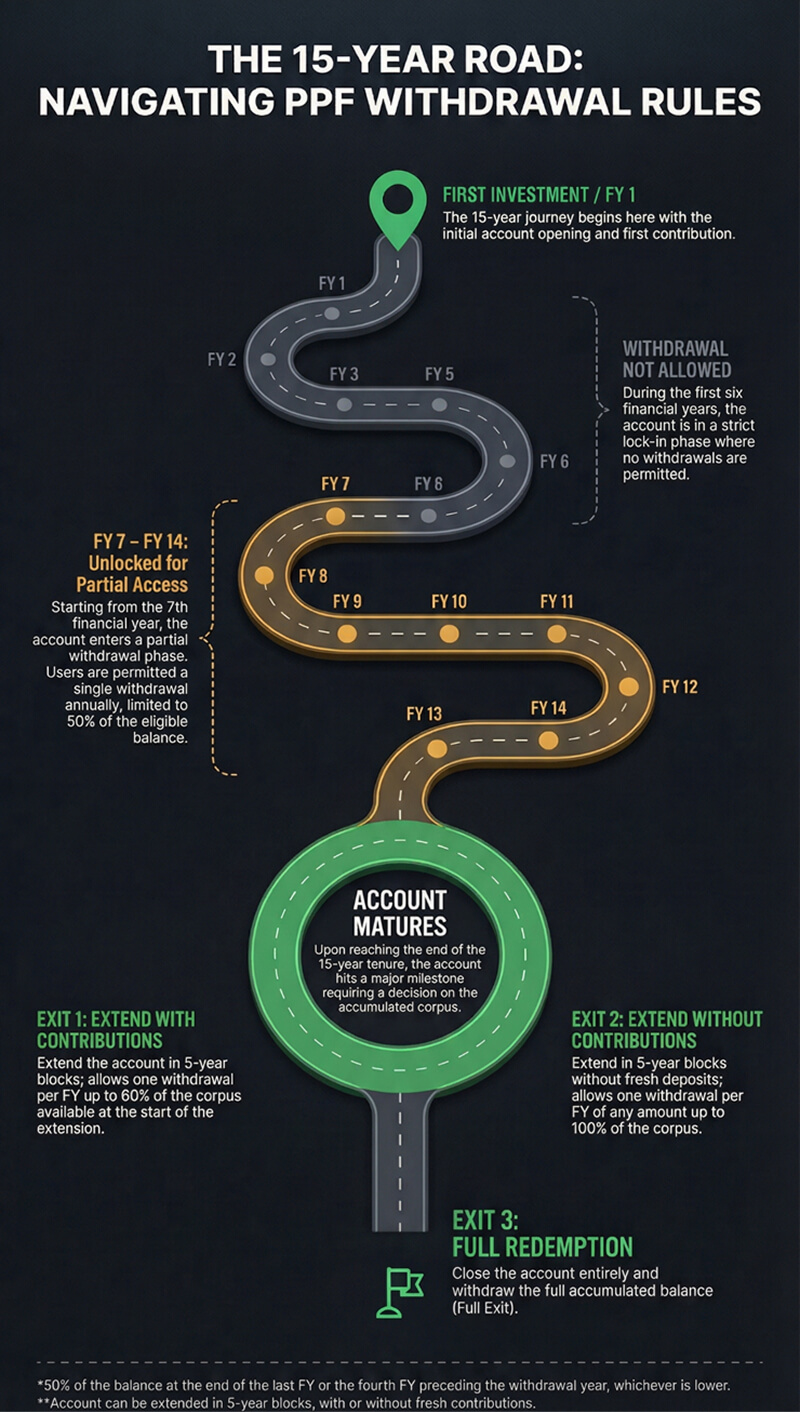
If your account was opened in FY 2010–11, your first eligible partial withdrawal year is FY 2017–18 i.e. the 7th financial year of the account. The National Savings Institute’s scheme documentation confirms this as the operative rule, though some sources loosely describe it as ‘after 5 years’ because premature closure (a different thing entirely) becomes available at that point. These are not interchangeable, and the distinction matters to an employee who has held an account for exactly 5 years and believes they can withdraw freely.
The withdrawal cap is the lower of two figures: 50% of the balance at the end of the financial year immediately preceding the withdrawal, or 50% of the balance at the end of the 4th financial year preceding the withdrawal. Only one withdrawal is permitted per financial year, and it must be in multiples of ₹50.
The 4-year lookback prevents last-minute lump-sum deposits to inflate the withdrawal base. The government anchors the cap to a historical balance precisely so the benefit cannot be gamed in the year before withdrawal.
The employee will also be asked to state the purpose of the withdrawal on Form C, though no documentary evidence is required the way it is for premature closure. One withdrawal, one financial year, one form. The simplicity of the mechanics is belied by how often the eligibility calculation is done incorrectly.
Also Read: 5 Basic Steps in Processing Payroll - What's Actually Involved?
Premature Closure Conditions
Premature closure of a PPF account is only allowed after five complete financial years from the end of the financial year in which the account was opened. Before that threshold, the account cannot be closed under any circumstances. The 5-year lock is absolute.
After the threshold is crossed, closure is permitted under exactly three conditions:
Life-Threatening Illness
Payroll teams should not attempt to assess whether a medical condition meets this threshold. Direct the employee to their bank with the certificate and let the institution make that determination.
Higher Education
The institution must be recognised under the relevant regulatory authority – an unrecognised private coaching centre or informal programme will not satisfy the condition.
Change in Residency Status
Once residency status changes to NRI, fresh contributions to the PPF account are no longer permitted under FEMA regulations. The account may continue to earn interest and remain open until maturity but cannot be extended beyond the 15-year term under any circumstance.
Also Read: Decoding Your Paycheck: Everything About Payroll Structure Explained!
What Happens at Maturity and After
At the end of 15 financial years, the employee has three options:
A
Withdraw and Close
They can withdraw the entire corpus and close the account by submitting Form C. The full amount is credited to the linked savings account, fully tax-free under the EEE structure.
B
Extend with Contributions
They can extend the account for a block of 5 years with continued contributions by submitting Form H within one year of maturity. The employee can withdraw up to 60% of the balance that existed at the time of extension, spread across the 5-year period with one withdrawal per year.
C
Extend without Contributions
They can extend without contributions in which case the account continues earning interest and they can make one withdrawal per year, up to and including the full balance. If no formal extension option is chosen, the account is treated by default as extended without contributions.
Also Read: Choose the Best Payroll Software for Your Small Business
About Form C and Tax Deductions
The form that governs all PPF withdrawals is Form C, officially titled ‘Application for Withdrawals under the Public Provident Fund Scheme, 1968.’ It is available from the bank branch or post office where the PPF account is held. Major banks including HDFC, SBI, and ICICI host downloadable versions in their form’s libraries. The National Savings Institute maintains the original scheme documentation at nsiindia.gov.in.
Form C has three sections:
A declaration where the subscriber states the account number, the amount requested, and the number of financial years elapsed
A certification section used only when withdrawing from a minor’s account
A bank details section for the credit destination
The subscriber signs and encloses a copy of the passbook. For premature closure, a separate closure request form accompanies it along with the relevant supporting documentation.
Processing time typically runs between 7 and 15 working days, though online submission through netbanking has compressed this significantly for accounts at major private banks. The amount is credited directly to the linked savings account.
The EEE Tax Structure
PPF operates under the Exempt-Exempt-Exempt (EEE) structure. Contributions qualify for tax deduction under Section 80C. The interest credited annually is entirely tax-free. Withdrawals are also fully tax-free, regardless of the amount withdrawn, as long as the withdrawal is within the scheme rules.
Accounts teams sometimes flag PPF withdrawals as taxable receipts during payroll reconciliation or income tax declaration season, when employees list withdrawal proceeds under income.
The misclassification typically happens when employees list withdrawal proceeds under ‘other receipts’ in their annual investment declaration or when accounts teams see a large credit in the linked savings account and treat it as income during payroll reconciliation.
India treats PPF interest as tax-free. Some countries do not. The United States, for example, taxes the interest earned on PPF under domestic rules. Employees who have become NRIs with continuing PPF accounts should be directed to a tax consultant with cross-border expertise. Knowing enough to redirect correctly is the mark of a payroll team that has done its reading.
Responsibilities of the Payroll Teams
Where payroll teams do have a role is during investment proof submission season. Employees declare PPF contributions under Section 80C in Form 12BB. Your team should know how to validate a PPF passbook entry, identify if declared contributions exceed the ₹1.5 lakh annual ceiling, and flag mismatches before they create TDS miscalculations.
The strongest payroll and HR teams treat employee financial literacy as part of the employment value proposition. That does not mean running financial planning sessions for everyone. It means knowing enough to say the right thing when an employee asks when they can touch their PPF money, or whether their premature closure will affect their tax return, or whether HR needs to be involved at all.
Conclusion
PPF withdrawal rules are not complicated once the scheme logic clicks. The lock-in is 15 years. Partial access opens from the 7th financial year at a capped amount. There is a loan facility between Years 3 and 6 that most employees never use because nobody tells them about it. Premature closure is possible after 5 years but not without a penalty and not without documentation. The PPF scheme has been governed by the same foundational structure since 1968; the rules move slowly and the changes that do occur are announced by the Ministry of Finance with enough lead time to absorb.
Frequently Asked Questions
No. PPF is a personal savings account held directly between the employee and their bank or post office. The employee submits all forms directly to their account-holding institution. If an employee is asking HR to sign or approve anything related to their PPF, they have been misinformed and should be redirected to their bank.
Yes, and employment status is entirely irrelevant to PPF withdrawal eligibility. The scheme rules are based purely on how long the account has been open and which financial year the account is in. Resignation, termination, or continued employment have no bearing whatsoever. This is one of the clearest distinctions between PPF and EPF.
The nominee or legal heir submits Form G at the account-holding bank or post office along with the death certificate and their own identity and address proof. The full corpus is paid out to the nominee regardless of how many years the account has been open and the 5-year premature closure threshold and the 1% penalty do not apply in the case of death. The account cannot be continued by the nominee in their own name. It is closed and the proceeds credited.
Yes. The employee submits a transfer request through Form SB-10(b) at post offices, or the bank’s internal transfer application at the current institution. The account history, balance, and tenure all carry over. The PPF account number may change but the subscription history and tax treatment remain unaffected.
Yes, subject to conditions. The account can continue earning interest and remain open until maturity. Fresh contributions are not permitted once residency status changes to NRI under FEMA regulations. The employee may opt for premature closure after the 5-year threshold with the standard 1% retroactive interest penalty applied. The account cannot be extended beyond the original 15-year term under any circumstance. Direct any NRI employee with a continuing PPF account to a tax consultant with specific cross-border and FEMA expertise before they make any decision.
Comments