TL;DR
CTC and take-home salary are not the same number - and the gap between them is one of the most common sources of employee dissatisfaction and early attrition. This blog breaks down exactly what CTC includes, how gross and net salary are calculated, and why a ₹ 10 LPA package typically lands between ₹ 65,000 and ₹ 68,000 in hand every month. Useful for HR teams who want to communicate compensation clearly and avoid the confusion that starts at the offer stage.
Introduction
One of the most frequent friction points in talent acquisition and retention is the disparity between the "Offer Value" (CTC) and the "Bank Credit" (Net Salary). When an employee accepts a ₹ 12 LPA offer but perceives a shortfall in their monthly inflow, the resulting dissatisfaction can impact morale and increase attrition risk. This guide goes beyond the acronym to explore the technical CTC meaning, detailing the breakdown of Gross and Net Salary, providing the formulas and structural models necessary for transparent compensation management.
CTC Meaning
While CTC meaning is literally 'Cost to Company,' in practice, it refers to the total financial expenditure or the total amount a company spends in a year to employ someone.
This includes:
Monthly cash compensation (Basic + allowances)
Statutory employer contributions (PF, ESI)
Long-term benefit provisions (gratuity)
Insurance premium payments
Performance-linked variable pays
Non-cash benefits (food coupons, transportation, wellness programs)
Similarly, expected CTC (Cost to Company) is the total yearly compensation a candidate expects from an employer, including salary, bonuses, allowances, and benefits.
When an organization offers "10 LPA CTC," it means the company has allocated 10 lakhs per year as the total cost of employing that individual. This figure is not the amount the employee receives in their bank account. The actual take-home salary is lower, as several deductions are applied before payment.
Deductions exist because the salary structure includes statutory payments and benefit contributions that must be settled before the net salary is credited. These amounts do not go to the employer. They are paid to different statutory bodies or benefit funds on the employee's behalf.
In other words, CTC reflects the employer's total cost per employee, not the employee's earnings. For this reason, companies rely on CTC rather than take-home pay when planning team expansion or setting departmental budgets.
Also Read: Is Leave Encashment Taxable?
CTC vs In Hand Salary
Employee compensation flows through three distinct stages before reaching their bank account. Understanding these stages helps organizations communicate compensation clearly and manage expectations effectively.
CTC (Cost to Company)
This is the macro budget allocated for the role. It includes immediate cash outflows, deferred payments (PF/Gratuity), and third-party payments (Insurance premiums). It reflects the organization's total investment in the resource.
Gross Salary
Gross Salary represents the employee's earnings before personal statutory deductions.
Inclusions: Basic Salary, HRA, Special Allowance, Leave Travel Allowance.
Exclusions: Employer-side contributions (Employer PF, Employer Insurance). These components are part of the CTC but never appear on the employee's earnings statement.
In-Hand Salary (Net)
Often referred to as "In-Hand," this is the final transfer to the employee after all statutory and voluntary deductions.
Deductions: Employee PF, Professional Tax, Income Tax (TDS).
This is the actual amount credited to an employee's bank account after all applicable deductions. It is calculated as gross salary minus mandatory and optional deductions. Mandatory deductions include income tax and professional tax, where applicable under state law. Provident Fund is typically an optional contribution, depending on salary level and company policy, though many employees continue it for long-term savings.
As salaries increase, the difference between CTC and take-home pay tends to widen, largely due to higher income tax slabs and increased statutory contributions.
Main Components of CTC/Salary Structure
A well-structured CTC balances organizational costs, statutory compliance, tax efficiency, and employee satisfaction. Most compensation structures include four primary buckets:
Basic Salary
Basic salary forms the foundation of the entire pay structure. In most organizations, it is typically set at around 40% of the total CTC. This proportion is important because several statutory components such as Provident Fund, gratuity, and other benefits are calculated as a percentage of basic pay.
PF calculations use Basic (12% of Basic)
Gratuity calculations use Basic
Bonuses often calculated as percentage of Basic
With the introduction of the new labour codes, there is a stronger emphasis on maintaining a higher basic component to ensure fair social security contributions and compliance with wage definitions. As a result, many companies are gradually restructuring salaries to keep basic pay 50% or half of the monthly gross amount. Higher basic means better retirement savings but slightly lower monthly take-home (because PF deduction increases).
Also Read: Salary Arrears in India: Meaning, Calculation, Format & Tax Rules Explained
Dearness Allowance (DA)
Dearness Allowance is mainly used in government and public sector roles to help salaries keep pace with inflation. It is revised at regular intervals based on changes in the Consumer Price Index, so employees are not hit as hard by rising living costs. In private companies, DA is rarely shown as a separate component. Instead, inflation adjustments are usually built into basic pay and annual salary hikes, which is why DA is largely absent from private-sector salary structures.
House Rent Allowance (HRA)
A salary slip usually includes multiple allowances; each meant for a specific purpose. House Rent Allowance, or HRA, is meant to cover rental expenses. In many standard salary structures, HRA is set at around 40% or 50% of basic salary.
Employees who pay rent can claim HRA exemption under the income tax rules, subject to prescribed limits. The exemption is calculated based on rent paid beyond 10% of basic salary, along with the applicable percentage of basic salary for metro and non-metro cities.
In practice, many employees miss out on this benefit simply because they are unaware of how the exemption works or how to declare it. A simple explanation or reminder during onboarding can help employees take advantage of HRA and meaningfully reduce their tax outgo.
Education Allowance
Education allowance is meant to cover children's education expenses. Under tax rules, it is exempt up to a small monthly limit per child, subject to a maximum of two children.
Any amount paid beyond the exempt limit becomes taxable. In many salary structures, this allowance appears as a fixed component even though only a portion of it qualifies for exemption.
Uniform Allowance
Uniform allowance is provided to cover the cost of purchasing and maintaining work-specific uniforms. Its tax treatment depends on actual usage. If the allowance is used strictly for uniforms required for the job and supported by expenses, it may qualify for exemption. Otherwise, it is treated as taxable income.
Education Allowance
Education allowance is meant to cover children's education expenses. Under tax rules, it is exempt up to a small monthly limit per child, subject to a maximum of two children. Any amount paid beyond the exempt limit becomes taxable. In many salary structures, this allowance appears as a fixed component even though only a portion of it qualifies for exemption.
Special Allowance
Special allowance acts as a balancing component in the salary structure. It covers any remaining amount after allocating basic pay and other defined allowances. Since it does not fall under any specific exemption, it is fully taxable. Organizations commonly use this component to adjust CTC without affecting statutory-linked elements like basic pay.
Bonus
Bonus is not always a one-time annual payout. In many organizations, it appears as a fixed monthly component on the salary slip. Some companies treat it as guaranteed pay, while others keep it genuinely variable and link it to performance, paying it quarterly or annually.
When a significant portion of CTC is labelled as variable bonus but is rarely paid out in full, employees often end up earning much less than what the headline CTC suggests. This gap is one of the most common reasons for confusion and dissatisfaction around compensation.
Employer's Provident Fund
Statutory requirement: 12% of Basic
EPF directly goes into the employee's EPF account. They can track it on the EPFO portal. It earns approximately 8% interest annually. For instance, ₹ 62,400 annual contribution over 25 years at 8% compound interest is approximately ₹ 50 lakhs retirement corpus.
Gratuity
Not visible on monthly salary slips because it's paid only when leaving (after 5 years minimum service). Employees often believe gratuity accumulates in their account monthly. It doesn't. Organizations provision for it internally, but employees receive it only as a one-time payment when leaving after 5 years which is approximately 4.81% of Basic annually in CTC calculations which is set aside internally for gratuity.
HR recommendation: During exit interviews, explain gratuity calculations clearly. Many employees underestimate their final settlement amount because they don't understand how gratuity works.
Insurance Premiums
Many organizations include insurance benefits as part of the overall compensation package. These usually cover group health insurance for the employee and their family, group term life insurance, and accidental death or disability coverage.
The company pays the insurance provider directly, which is why these amounts never appear on the employee's salary slip. However, the premium paid by the employer is still included in the CTC because it represents a real cost to the organization.
From the employee's perspective, the value lies in the coverage, not the premium itself. While the employee does not receive this amount as cash, they gain access to insurance protection worth several lakhs, often at a fraction of what an individual policy would cost.
Understanding Gross Distribution
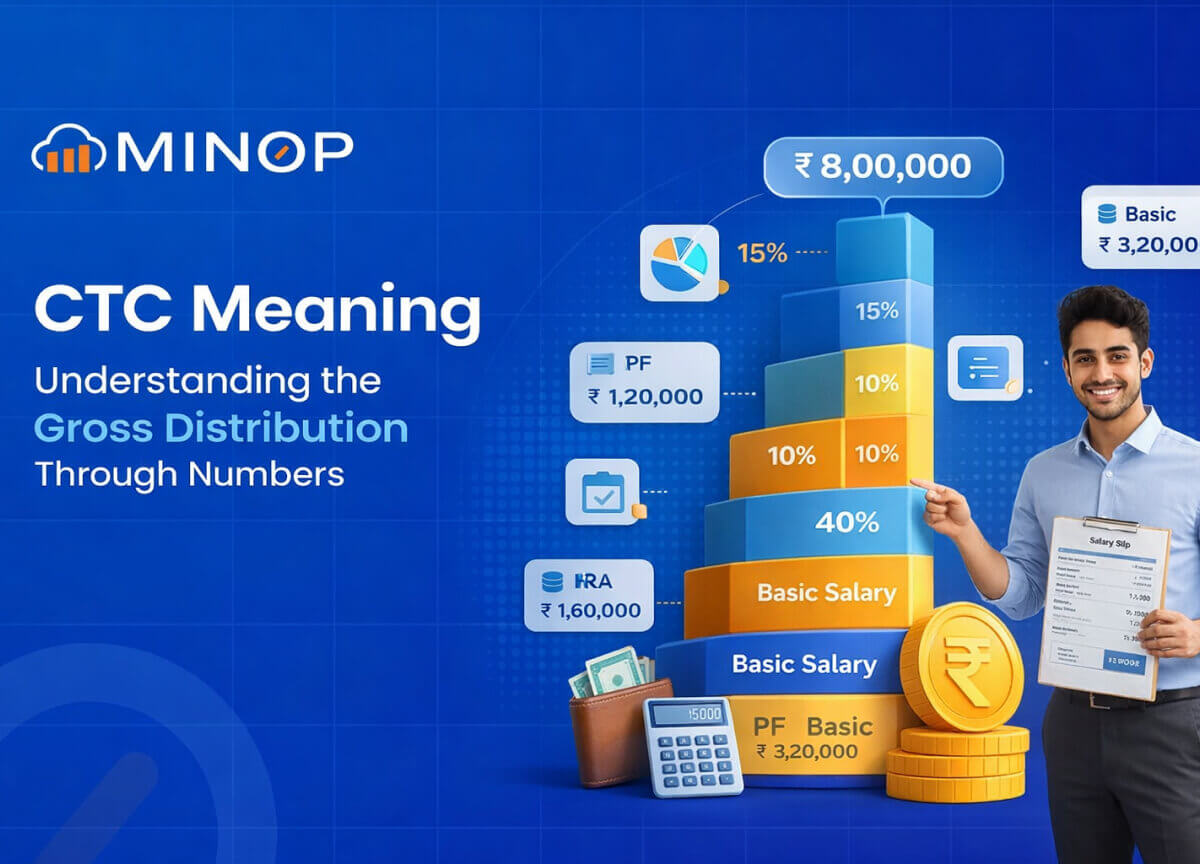
As mentioned earlier, the Basic Salary usually comprises 40% of the total CTC (or 50% under the new wage code). This percentage is crucial because the major deductions are calculated based on it:
Provident Fund (EPF): The employer sets aside 12% of basic.
Gratuity: Another 4.81% of Basic is allocated for gratuity.
Professional Tax: A standard flat deduction of ₹ 200 is typically applied.
The math always starts at the source: the CTC. To arrive at Gross Pay, simply take the CTC and subtract the employer's contributions (like the PF and Gratuity mentioned above). Even if a specific company doesn't offer PF or Gratuity, the formula remains the same: CTC minus Total Employer Deductions equals Gross Pay.
Once we have the Gross Pay, the final step is distribution. We need to assign actual numbers to these percentages and distinguish between what is calculated annually versus what is deducted monthly.
This can get confusing in theory, so let's understand it better with a real-world example.
Example: ₹ 10 LPA CTC Breakdown
Let's use 40% of CTC = ₹ 4,00,000 annually (₹ 33,333 monthly)
Employer's PF: 12% of ₹ 4,00,000 = ₹ 48,000
Gratuity: 4.81% of ₹ 4,00,000 = ₹ 19,240
Minus employer costs: ₹ 67,240 (PF + Gratuity)
Available for Gross: ₹ 9,32,760 (₹ 77,730 monthly) (CTC - Employer Cost)
Gross Distribution
Basic: ₹ 33,333 (40% of CTC)
HRA: ₹ 16,667 (50% of Basic - standard practice)
Bonus: ₹ 2,800 (fixed monthly component)
Education Allowance: ₹ 400 (₹ 200 per child, max 2 children)
Uniform Allowance: ₹ 3,000
News Paper & Periodicals: ₹ 1,500
Special Allowance: ₹ 20,030 (balancing figure)
Take-Home
Monthly Gross: ₹ 77,730
Employee PF (12% of Basic): ₹ 4,000
TDS (estimated):₹ 8,500
Professional Tax: ₹ 200
Also Read: Everything About Payroll Structure Explained!
| Component | Monthly Allocation (₹) | Annual Allocation (₹) | Strategic Note |
|---|---|---|---|
| Basic Salary | 33,333 | 4,00,000 | 40% of CTC |
| HRA | 16,667 | 2,00,000 | 50% of Basic |
| Special Allowance | 20,030 | 3,17,760 | Balancing Figure |
| Gross Salary | 77,780 | 9,32,760 | Employee Earnings |
| Less: Employee PF | 4,000 | 48,000 | 12% of Basic |
| Less: Prof. Tax | 200 | 2,400 | State-dependent |
| Less: TDS (Est) | ~2,900 | ~35,000 | New Regime Est. |
| Net Pay (Disbursal) | ~65,030 | ~7,80,360 | Liquidity |
Final Thoughts
Ultimately, a clear grasp of CTC meaning and how it translates into actual earnings directly impacts how organizations attract and retain talent. However, executing these sophisticated structures requires more than just theoretical knowledge; it demands robust infrastructure. The emergence of cloud-based time and attendance SaaS tools has become indispensable for bridging the gap between policy and practice. Adopting such technology eliminates the "missing component" confusion and reinforces trust, proving that the organization is as committed to operational excellence as it is to fair compensation.
For organizations looking to see how these principles play out across different salary levels, the detailed salary slip format guide provides concrete examples, breaking down each component with actual numbers that HR teams can reference during candidate conversations or employee queries.
Frequently Asked Questions
Generally, 70-82%, depending on tax bracket, statutory deductions, and salary structure. Higher-income employees (> ₹ 15 LPA) may see lower percentages (68-72%) due to higher tax rates.
Yes. Restructuring Special Allowance into HRA (for rent-paying employees), meal vouchers, and NPS contributions can increase net take-home by 5-10% with zero impact on organizational cost.
Yes, for organizations with 10+ employees, gratuity is legally mandated. Organizations provision for it monthly in CTC but pay employees only upon eligible separation (after 5 continuous years of service).
Professional tax is a state-level levy. Maharashtra, Karnataka, West Bengal, and Tamil Nadu charge approximately ₹200-300 monthly. States like Delhi, UP, and Rajasthan don't impose professional tax. Organizations must update payroll when employees relocate between states.
Comments