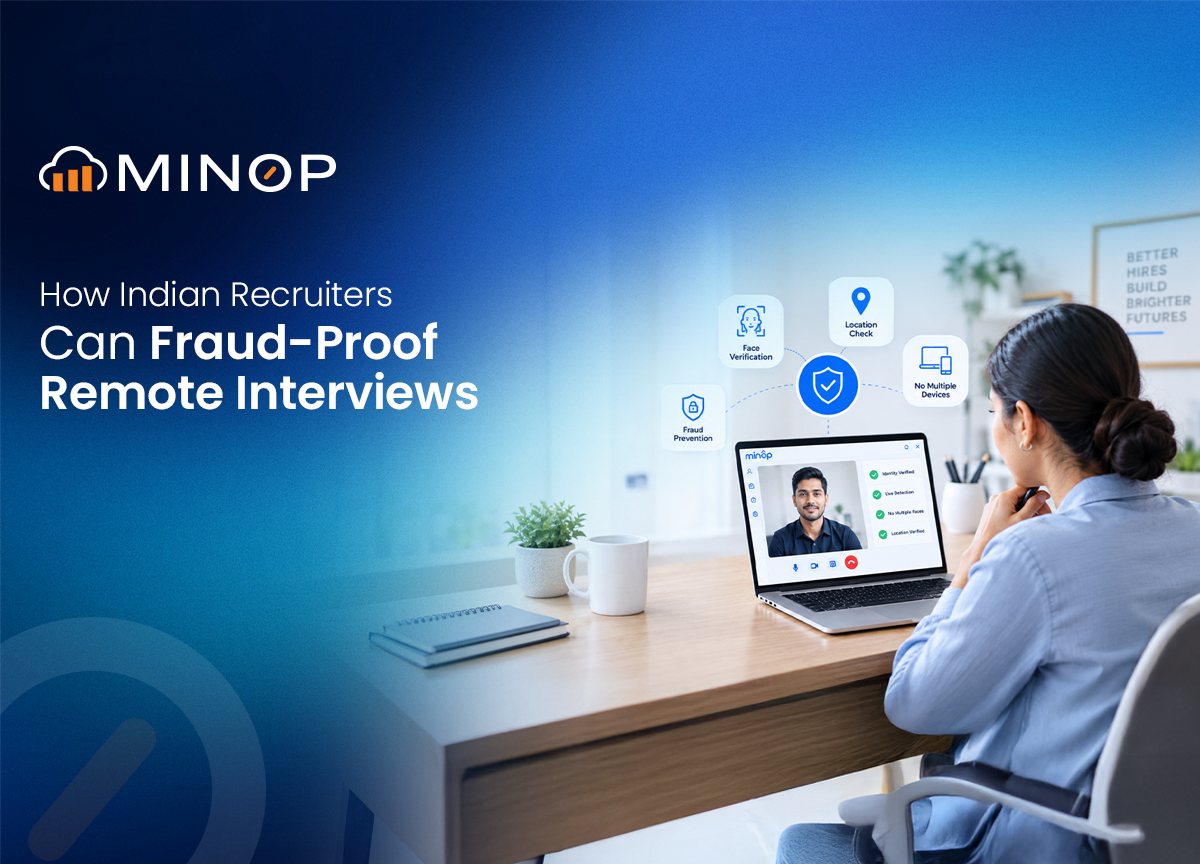
Ask a suspicious candidate to wave a hand in front of their face. According to a recent FBI advisory, that is one of the simplest ways to break a live deepfake overlay on a video call.
That one tip shows how far remote interview fraud has come. Recruiters in India are no longer dealing only with inflated resumes. They face proxy test-takers, real-time AI answer tools and face-swapping software, all aimed at well-paid remote roles in IT services and Global Capability Centers (GCCs).
This guide explains how the fraud works, where it gets through and how to build a layered defence without turning interviews into interrogations.
How big is interview fraud in India?
Bigger than most hiring teams assume. The 2026 Global Workforce Trends Report by First Advantage, which draws on over 200 million background screens, found that Asia Pacific has an 88% incidence rate of candidate verification issues. In the same research, 45% of surveyed HR professionals said they had directly encountered candidate identity misrepresentation. The Economic Times has likewise reported that AI-driven cheating affects up to 45% of tech assessments.
The problem is global, too. Gartner predicts that by 2028, one in four candidate profiles worldwide will be fake. In a Q2 2025 Gartner survey of 3,000 candidates, 6% admitted to taking part in interview fraud, either posing as someone else or having someone pose as them. Experian’s 2026 Future of Fraud Forecast named deepfake candidates among its top five fraud threats for the year.
Three forces drive it:
Remote hiring reach: Companies now hire from tier-2 and tier-3 cities without relocation, which widens the talent pool and the attack surface.
Cheap AI tools: Real-time transcription, voice cloning and face-mapping software are easy to get.
Volume and pressure: Large hiring pipelines and a competitive job market push desperate candidates, and organised proxy agencies, towards shortcuts.
The problem started in IT, where coding tests are easy to fake. It is now spreading into BPO, remote finance and healthtech.
What types of interview fraud should recruiters know?
Each type is caught by a different signal, which is why no single check covers them all.
| Fraud type | How it works | What catches it |
|---|---|---|
| Proxy interview | A stronger person sits the live round under the applicant’s name | ID check at the start, same face in every round |
| Deepfake video or voice | Synthetic media masks or replaces the real person on camera | Live challenges: head turn, ID beside face, unexpected on-screen change |
| AI-assisted answers | A model feeds real-time answers to the real candidate | Unscripted follow-ups, asking the candidate to explain their own last answer |
| Resume and credential fraud | Fabricated employers, titles or dates | Specific, checkable questions about claimed work |
In proxy interviewing which is also known as bait-and-switch, a skilled expert clears the technical rounds, and a different, less-skilled person joins after the offer. There is also lip-syncing where the candidate mouths the words while a hidden expert speaks into a Bluetooth mic or controls the screen remotely. This was the dominant tactic in the 2020 to 2022 remote boom.
Moreover, in the case of real-time video inference (deepfakes), the modern version. As documented by Glider AI, candidates use virtual camera drivers to overlay a different face in real time. This is often paired with voice cloning and tools that transcribe your questions and generate answers on screen.
There are also AI-assisted answers where the real candidate appears, but a second monitor runs a model that feeds them answers. This is most common in technical and case-style rounds. The origin of this type of fraud generally comes from resume and credential fraud with invented employers, titles or dates. Specific questions about claimed work, such as the metric they moved, the tool version they used or the person they reported to, expose it fastest.
How can recruiters fraud-proof remote interviews?
Post-offer background checks alone are too late. By the time they catch a mismatch, you have already spent weeks of recruiter and engineering time. A webcam feed is also a weak source of truth, since compression, lag and virtual backgrounds all reduce confidence, and good deepfakes make “it looked fine to me” unreliable. Use layers.
Verify identity upstream, before the interview
First Advantage reports 103% growth in employers moving verification to the start of the process. In practice, that means:
Integrating API-based government checks into your ATS or HRMS, for example DigiLocker-based verification.
Requiring a live selfie, with the candidate’s consent, that is matched to their Aadhaar or PAN record before the interview link unlocks.
Asking the candidate to hold their ID beside their face at the start of the first video round, and taking a screenshot to compare with later rounds and onboarding.
Note the difference between the two methods. An on-camera ID check only documents that an ID was presented. An API-based check against a government record is a stronger, separate layer.
Keep identity continuous across every round
A proxy often taps out after the easy first call. Require camera-on in every round and compare the person with the verified ID each time. Treat verification as a chain, not a one-time event: if a different person can appear later without detection, the first check did not do its job.
Under India’s DPDP framework, collect and retain only the personal data necessary for the stated purpose. For identity verification, that can mean keeping an audit record of the verification rather than retaining copies of identity documents when those copies are not necessary.
Use purpose-built proctoring, with human review
A standard Zoom or Teams call gives you no protection. Assessment platforms lock the browser and look for biometric anomalies: lip-sync lag, unnatural blinking, missing eye reflections, multiple voices in the room, and the fixed gaze of someone reading from a hidden screen.
Treat these flags as signals for review, not automatic rejection. A child walking into the frame or a candidate looking away to think can trigger a false alert. Tell candidates up front why the tools are used and frame it around fairness, not suspicion.
Run quick on-camera checks
These cost nothing and work on live calls:
Hand wave or head turn: Ask the candidate to wave a hand across their face or turn their head fully to the side. A real person looks mildly puzzled. A deepfake overlay tends to glitch or tear.
Live challenges: Ask them to hold their ID next to their face, or to describe a change you just made on screen. These are trivial for a real person and hard for a real-time synthetic pipeline.
360-degree workspace view: Before a technical round, ask for a quick pan of the room. Look for second screens, extra keyboards and earpieces. Make it a standard step for every candidate so it never feels personal.
The mic interruption: Say, “Could you adjust your microphone? The sound is crackling.” If the voice keeps going while the candidate on screen is busy with the mic, you have likely found a lip-sync setup.
Hands visible and full-screen share: Ask candidates to keep their hands in frame and share the entire screen, not one browser window.
Ask questions a script can’t answer
Fraudsters depend on predictable questions. “What is polymorphism?” is easy to feed to a proxy or an AI tool. Instead, go deep on the candidate’s own work:
“You said you cut app load time by 20% at your last company. What pushback did you get from QA, and how did you handle it?”
Then probe the answer they just gave: why that approach, what would break it, what they would do differently. Real experience survives this. A fed answer usually does not. Candidates who give polished technical answers but stall on spontaneous follow-ups are a red flag.
Assess live, not take-home
Take-home tasks and unmonitored tests are the easiest to fake. Use live pair-programming or shared-editor sessions where you can watch the keystrokes. Sudden “copy-paste drops” of large, perfect code blocks are a warning sign. Watching how a candidate debugs and recovers from mistakes tells you more than a finished product.
Add an in-person or re-verified final step for critical roles
Many Indian companies now do initial screening remotely via a mobile app for efficiency, then hold the final round in person at the nearest regional office, or re-verify identity on camera at the final round. For roles with access to customer data, production systems or financial tools, and for senior technical hires, this step is worth the friction.
Bottom Line
Deepfakes and voice cloning are improving quickly, so detection will lean less on catching candidates in the act and more on verified credentials, continuous skill assessment and layered identity checks. Teams that build upstream verification and live, conversational assessments now will be better prepared than those that rely on one-off tricks.
Frequently Asked Questions
A proxy interview is candidate fraud where the person in the virtual interview is not the real applicant. Typically, a skilled expert takes the technical round for a less-skilled candidate, who then joins the company after the offer. It is caught by verifying identity before the first interview and by requiring the same camera-on person in every round.
Ask the candidate to wave a hand in front of their face, turn their head to the side or hold their ID beside their face. Real-time synthetic video struggles with sudden, unscripted requests and may glitch or tear. Also watch for lip-sync lag, unnatural blinking, delayed responses and difficulty with unscripted follow-up questions.
Match a live selfie to an Aadhaar or PAN record, with the candidate’s consent, before the interview link unlocks. Ask candidates to show a government ID on camera at the start, and compare a screenshot with the person who appears in later rounds and at onboarding. Record that verification happened without storing more data than necessary.
High competition for well-paid roles, unmonitored or asynchronous coding rounds, and cheap AI tools such as real-time transcription and deepfake camera drivers make cheating easy to automate from a remote setting. Remote hiring also removed the in-person final round that once made impersonation difficult.
Comments