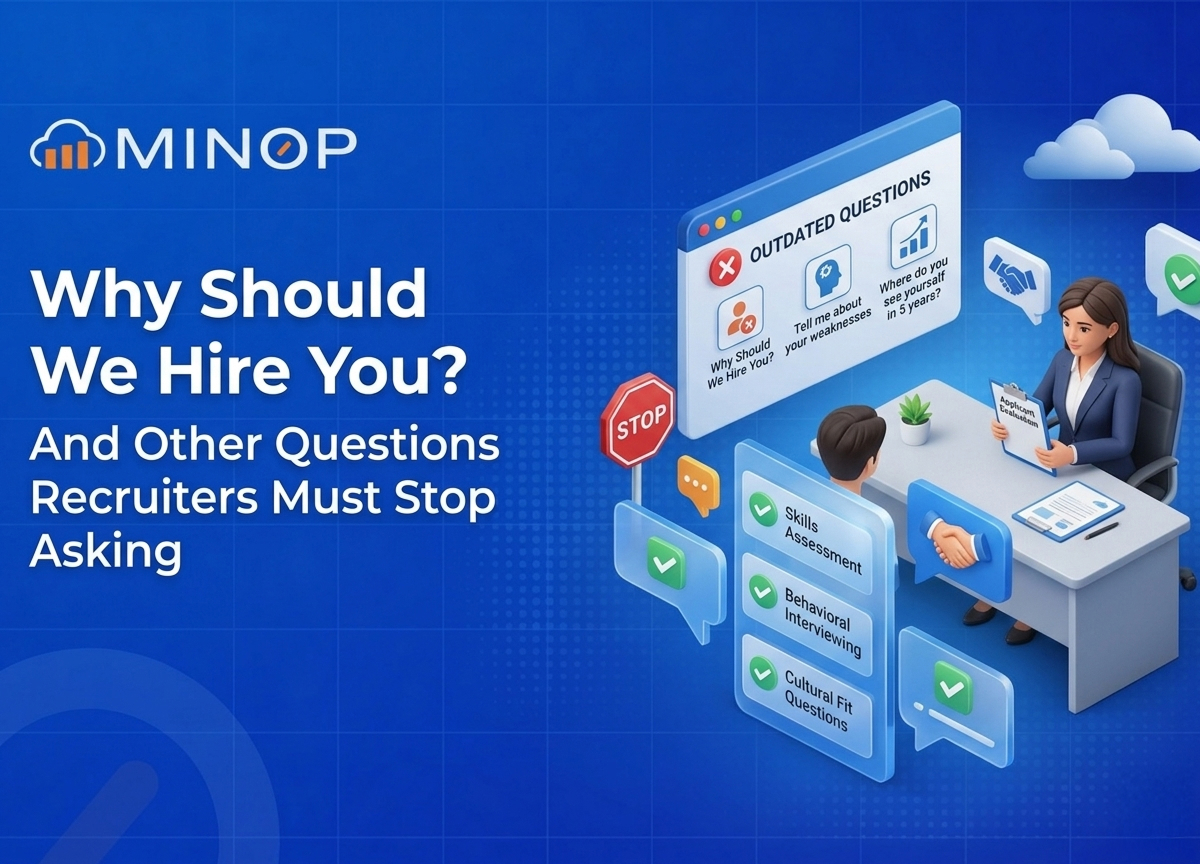
TL;DR
“Why should we hire you?” is one of the most repeated interview questions in history – and one of the weakest predictors of actual job performance. This article breaks down why this and similar questions reward rehearsed performance over real potential, what the research says about effective hiring, and which questions smart talent acquisition professionals are asking instead.
Introduction
With so many layoffs reshaping industries today, it’s hard to grasp when it became normalised for interviews to stretch across so many rounds. Every company wants to do at least three, a phone screening followed by a one-on-one, then a meeting with an executive, and finally an additional in-person round. Some organisations run five or even six stages, with the entire process sometimes taking months to complete between each step, quietly driving away the very candidates they most want to hire.
It is quite inevitable at some point during these rounds to come across a question that poses as a filler but carries outsized weight in the evaluation process. One such question asked by employers and HR professionals alike is the now-infamous “why should we hire you.” Putting pressure on the candidate is one thing, as the answer requires a comprehensive overview of key differentiators to sell one’s skillset and talent without going overboard.
However, recruitment specialists, over the years, have come to see this question as a weak predictor of job performance because one can’t really understand the scope of a candidate’s potential apart from their presentation skills. In other words, no one can really know if they can execute the tasks or not, but only the way they communicate with confidence and role understanding. So let’s understand why questions like these must be avoided in the first place.
Why Should We Hire You
Often asked at the end of the interview, “why should we hire you?” is designed to ensure the candidate has the specific skills, motivation, and cultural fit to solve the challenges they are being hired to solve. Considered the final “sales pitch,” today many progressive hiring specialists don’t ask this kind of question, and their reasons are well-grounded in decades of research.
The question is inherently biased toward candidates who are polished communicators – a trait that is valuable in some roles and almost irrelevant in others. A software architect, a research scientist, or a financial analyst may be deeply exceptional at their craft yet stumble when asked to deliver a confident monologue under pressure. Meanwhile, a candidate trained in interview coaching can deliver a flawless, keyword-rich answer without possessing a fraction of the skills they’re claiming. Recruitment is supposed to identify who can do the job, not who can best describe doing it.
“A structured interview should have already surfaced evidence of skills, motivation, and fit across multiple dimensions.”
Implicit in the question is a power dynamic worth examining: you must justify your existence in this room.This framing is not only uncomfortable – it actively disadvantages candidates from underrepresented backgrounds who may already carry a tax of self-advocacy in predominantly homogeneous workplaces. It reinforces the idea that hiring is something done to a candidate, rather than a mutual exploration between two parties evaluating each other.
Questions Recruiters Should Stop Asking

1. “What Is Your Greatest Weakness?”
A question so ritualised it has spawned an entire cottage industry of coached non-answers ?I work too hard,? ?I?m a perfectionist,? ?I sometimes take on too much.? No candidate with any preparation is going to deliver a genuine vulnerability assessment in a high-stakes setting. What you get is performance, not self-awareness. If the goal is to understand how a candidate handles limitations and growth, ask instead about a specific professional failure and what they changed afterward. The framing shifts from a theatrical confession to an evidence-based conversation about development.
Replace with:
Tell me about a time you received critical feedback and what specifically changed in your approach afterward.
2. “Where Do You See Yourself in Five Years?”
This question made sense in an era of linear career ladders and decade-long company tenures neither of which describes the modern workforce. Asking it in 2026 signals that your organisation is operating on outdated assumptions about ambition and loyalty. More critically, the honest answers are rarely given because candidates know what the interviewer wants to hear rather than what is actually true. Replace it with a question about what the candidate is actively trying to build right now it surfaces genuine motivation rather than a rehearsed vision statement.
Replace with:
What skills or experiences are you most actively building right now, and why?
3. “Tell Me About Yourself”
An open-ended opener that produces an open-ended mess. Candidates who have rehearsed a polished 90-second elevator pitch sound impressive. Candidates who haven’t – including some of the most capable technical professionals – ramble and lose the interviewer in the first two minutes. The question tests rehearsal, not relevance.
Replace with:
What drew you to this particular role at this specific point in your career?
4. “Are You a Team Player?”
No one has ever said no. It is, without question, the most reliably useless closed-ended question in the hiring toolkit. Every candidate says yes. Every interviewer knows they will say yes. The question survives because it feels like it should work, even though it has never produced a single actionable data point.
Replace with:
Describe a time you disagreed with a teammate. How was it resolved, and what was the outcome?
What Actually Predicts Job Performance
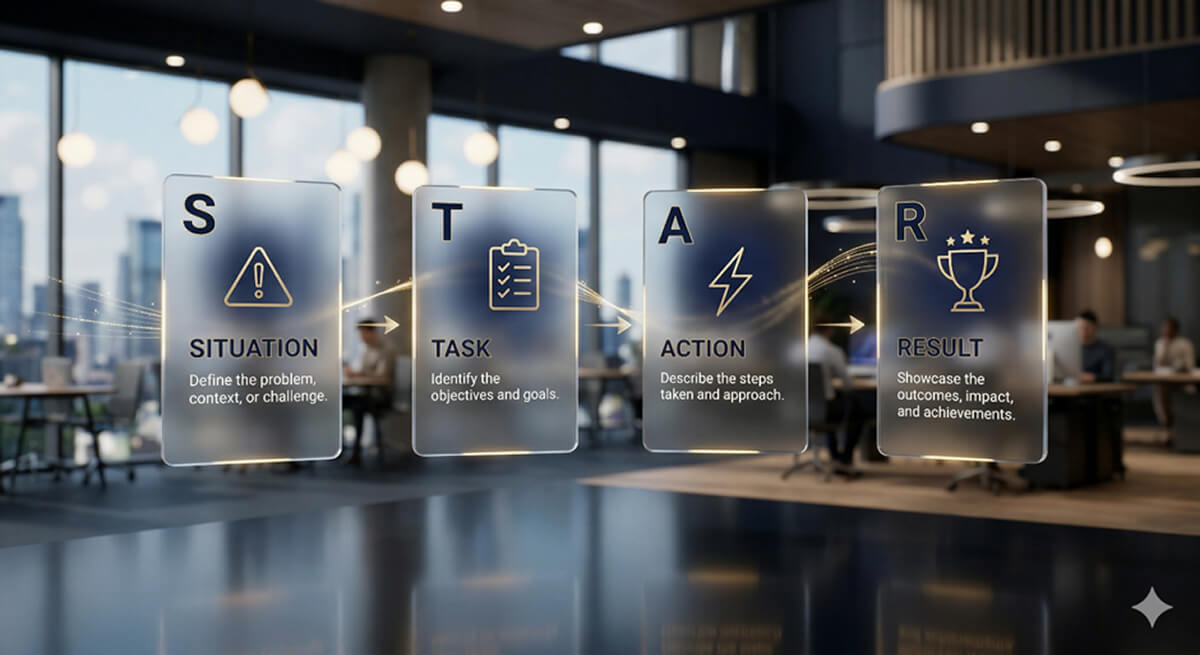
The STAR method: Situation, Task, Action, Result remains the gold standard for extracting behavioural evidence. The key is that questions must be specifically designed around the competencies the role demands, not selected from a generic bank of interview questions.
STAR
Situation, Task,
Action, Result
34%
Gap in predictive
accuracy
#1
Most cited hiring
reason:
“fit”
A question like “Tell me about a time you had to deliver a project under significant resource constraints” reveals evidence of prioritisation, stakeholder management, and resilience in a way that “Are you good under pressure?” never could. Structured interviews are also substantially more legally defensible than unstructured ones, because questions derived from job analysis and scored consistently can demonstrate content validity under equal employment guidelines.
“Sociologist Lauren Rivera found in her research on elite professional services firms that ‘fit’ was the single most cited reason for hiring, and was often a proxy for class similarity between interviewer and candidate.”
– Lauren Rivera, Northwestern University
The replacement is values exploration: structured questions about how a candidate makes decisions under ambiguity, how they have navigated ethical complexity, and how they have contributed to inclusive team environments.
Read More: Interview Warmup: The 15-Minute Ritual Elite Recruiters Practice
Final Thoughts
The interview is the single most high-stakes touchpoint between an organisation and its future talent. It is also, in many companies, its most casually designed one. Questions like “why should we hire you” persist not because they work but because they have been inherited without scrutiny.
The antidote is intentionality. Design questions anchored to specific competencies. Replace performance-theatre prompts with behavioural and situational questions that surface real evidence.
- Build a 15-minute warmup into your interview day.
- Recalibrate your question set for lateral hires.
- Handle no-shows with grace rather than frustration.
And recognise that the way you run an interview is a direct signal to every candidate about how your organisation actually operates. Better questions don’t just find better candidates. They build better companies.
Key Takeaway
The interview process is a two-way evaluation. Replace inherited, performance-theatre questions with structured behavioural and situational prompts that surface real evidence of capability. Tools like MINOP Cloud HR can help HR teams streamline their hiring workflows, track interview outcomes, and build data-driven recruitment practices that consistently identify the right talent.
FAQs
In limited contexts, such as a final executive conversation where interpersonal presence is a core job requirement, it can provide a data point on confidence and communication style. But for most roles, structured behavioural questions yield far richer and more predictive insight.
Three well-designed rounds are the evidence-backed upper limit before candidate attrition becomes a serious problem. A phone screen, a structured competency interview, and a final conversation covering values and team dynamics covers the necessary ground without demanding unreasonable time from candidates.
A structured interview uses predetermined, job-relevant questions asked consistently to all candidates and scored against a standardised rubric. An unstructured interview is a freeform conversation where questions vary by candidate and evaluations are based on overall impression – a 34% gap in predictive accuracy attributable entirely to design, not cost or time.