
Introduction
Taking an interview is the first step in the hiring process. For an interviewer, running a background check and preparing flexible questions based on a candidate's responses is part of the pre-interview ritual or interview warmup routine. This not only helps assess the candidate's accuracy and composure, but also reveals early signs of attitude, coachability, and emotional intelligence.
Many hiring managers skip interviewer tips because they believe the interview is only about asking questions and hearing answers. They're often not fully equipped with the technical knowledge of the role the candidate has applied for - that expertise usually sits with the team manager, who may have over a decade of experience in, for example, software development, but currently lacks a full team to meet client requirements.
In this guide, you'll learn interview techniques that help prevent new hires from failing within their first 18 months . A separate study of nearly five thousand hiring managers over three years found that their judgment tends to shift significantly between the first and fifth interview of the day.
This change in evaluator mindset can be stabilised with a simple 15-minute interview warmup ritual.
Why Most Interview Prep Fails
You already know how to interview. You've reviewed countless resume, asked hundreds of questions, and hired dozens of people. A difficult or frustrating candidate can influence how you judge the next one often without realising it. So why do some new hires fail to meet expectations even after multiple interview rounds?
Because your mind falls into predictable patterns.
You unconsciously compare each candidate to the one who came before.
Your brain reduces complex evaluations into quick gut reactions.
And you're still processing the last meeting, email, or problem while interviewing.
Research on decision fatigue shows that judges grant parole 65% more often after breaks than right before them. Your hiring decisions follow the same pattern except you're likely not taking breaks between interviews. Here, a consistently fair interview warmup prepares you for incoming subconscious biases.
Definition:An interview warmup is a structured, repeatable process that shifts your brain from operational mode into evaluative mode. The gap between quickly glancing at a resume and performing a deliberate warmup is the difference between reactive hiring and strategic hiring. Without this transition, your brain slips into gut feelings, familiarity bias, and snap judgments based on irrelevant details. With a proper interview warmup, you override these automatic responses and activate the analytical thinking that actually predicts hiring success.
The 15-Minute Interview Warmup Framework
This is the exact interview warmup process countless HR use before every interview. Total time: 12-15 minutes (or 5 minutes if you're genuinely squeezed).
Minutes
Change your current pattern and switch your phone to Do Not Disturb. Follow a simple breathing exercise: inhale for four counts, hold for seven, and exhale for eight. Then pick up a pen and write, in your own words, what you need to accomplish in the next ten minutes. These notes can be bullets, short sentences, or even single words. Include anything unusual you noticed in the candidate's resume or any specific instructions the manager has given for screening. Research shows that short cognitive breaks restore focus and prevent decision fatigue, yet most interviewers skip them entirely.
Related: 5 Basic Steps in Processing Payroll
Minutes
Next, open the job description and compare it with the candidate's CV. Note anything unusual and highlight it. Look for career progression patterns, key achievements, and core responsibilities, then generate two to three hypothesis questions. You're building a mental model of what success looks like and mapping this candidate against it. This shifts the interview from a discovery exercise to a validation exercise.
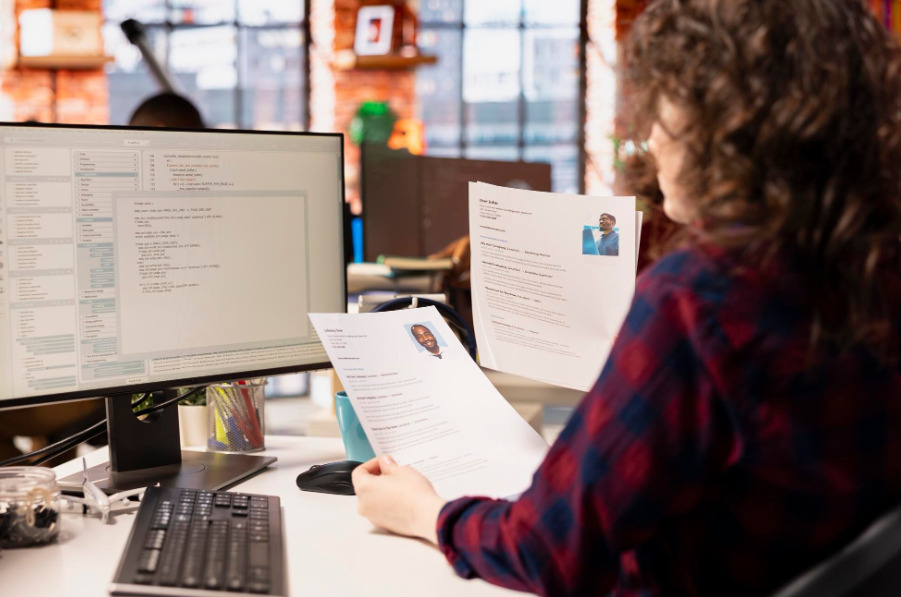
A thorough CV scan lets recruiters spot the right fit in seconds, shortlist confidently, and decide with precision.
Minutes
Script your opening in a way that matches the candidate's name, the job description, and the tone of the role. This isn't about memorising an introduction, but about helping both you and the candidate feel calm and grounded. After this, choosing the right questions becomes the core of your preparation, and a scripted opening gives you the flexibility to improvise later. Rely on the notes you made earlier and avoid generic questions.
Your decision on what to ask should flow directly from the "non-negotiables" you identified earlier. For each non-negotiable, prepare one primary behavioural or situational question, along with a follow-up probe. This structure reduces bias by ensuring every candidate is asked the same core questions. It also keeps the interview focused so you don't ramble, skip important topics, or let extroverted candidates dominate with charisma instead of substance.
The tone does everything and the pitch is perfected with practise done just before the interview. That's why breathing patterns play an important role in this interview warmup ritual.
Here is a sample opening script to get started:
"Hi Ayush, I'm Roopal Verma, HR Ops at Transcendence Tech LLP. Thanks for making time today. Here's how the next 45 minutes will go: I'll ask about your background and experience, then we'll walk through some specific scenarios related to your role. You'll have time at the end to ask me anything. Sound good? Great, let's start with..."
Minutes
The last few minutes before the interview are crucial. Stand up, move around, stretch, or take a short walk. Reset your energy - don't look tired, distracted, or frustrated from your previous call. Remind yourself: This person prepared. They took time off work. They deserve my full attention.
Why does this matter? Because candidates mirror your energy. Research on interviewer rapport shows that when candidates feel comfortable, they move past rehearsed answers and share genuine insights. If you show up flat or disengaged, even strong candidates will underperform. If you show up present and curious, even nervous candidates will open up.
What to do after the interview?
The warmup ends with a simple closing ritual. Right after each interview, spend five minutes capturing four things:
1. Rate the candidate on a 1 to 5 scale for each non-negotiable.
2. Note three specific examples they shared - direct quotes are ideal.
3. Write your gut feeling in one sentence: " I'd be excited/hesitant to work with them because�"
4. Flag any follow-up questions for the next round or for reference checks.
Memory fades quickly. Within an hour, you'll forget half the details. By the next day, you'll only remember the emotional impression. This five-minute capture keeps your hiring committee discussions grounded in evidence, not vague impressions.
Benefits of Doing Interview Warmup
When you implement this 15-minute warmup consistently, here's what changes:
Ask Better Questions
Because you've reviewed the role requirements and candidate profile, your questions probe actual competencies instead of generic experience. You stop asking "What's your greatest weakness?" and Memory fades quickly. Within an hour, you'll forget half the details. By the next day, you'll only remember the emotional impression. This five-minute capture keeps your hiring committee discussions grounded in evidence, not vague impressions.start asking "Tell me about a project which did not go your way, what would you do differently?"
Improve Candidate Experience
A prepared interviewer sends a clear message that your company respects candidates' time and takes hiring seriously. This approach directly influences offer acceptance rates, as candidates feel valued; strengthens your employer brand, since even rejected candidates speak positively about the experience; and reduces time-to-hire, by minimizing the need for re-interviews caused by unclear evaluations.
Reduce Unconscious Bias
The mental reset prevents you from comparing candidates to one another, falling into time-of-day judgment traps, or carrying emotional residue from earlier interviews. Research shows that structured interviews reduce bias by up to 50% compared to unstructured conversations. A proper interview warmup creates the mental space needed to consciously set these biases aside and approach each candidate with a fresh, fair perspective.
Maintain Consistent Energy
One of the most important parts of preparing for interviews as an interviewer is learning how to maintain the same level of energy in your last interview as you had in your first. Whether it's your first conversation at 9 a.m. or your sixth at 4 p.m., every candidate should receive the same quality of attention. This is how you avoid overlooking strong candidates simply because they interviewed at the wrong time of day.
Make Faster, More Confident Decisions
Paradoxically, spending 15 minutes preparing saves hours of post-interview deliberation. You know what you saw, why it matters, and how it maps to the role. Hiring committee meetings go from "What did you think?" to "Here's the evidence."

The right data, structured notes, and focused insights turn intuition into informed confidence.
The Do's and Don'ts of Interview Warmup Ritual
While the warmup sets the stage, your execution matters. Think of this as a quick summary of the do's and don'ts of interview conduct from a professional standpoint.
|
Do's |
Don'ts |
|---|---|
|
Put phone on DND; start with breathing reset. |
Don't jump into the interview without grounding. |
|
Jot quick notes on goals and red flags. |
Don't rush through resume patterns. |
|
Compare CV to JD with attention. |
Don't ask generic questions. |
|
Prepare hypothesis-based questions. |
Don't rely only on improvisation. |
|
Draft a warm intro to set tone. |
Don't skip key competency checks. |
|
Use breathing to maintain calm tone. |
Don't carry emotional fatigue forward. |
|
Move around before starting. |
Don't assume candidates open up automatically. |
The Bottom Line
Onboarding the ideal candidate requires a deep understanding of their mindset and the ability to ask questions they may not have prepared for; something only a skilled interviewer who has been in their shoes can do effectively. However, this momentum can easily break if you appear impatient, interrupt their answers, or fail to connect with their expertise because your mind is elsewhere.
The solution is a quick 10-15-minute interview warmup ritual. By resetting your preparation and controlling how you show up, you ensure the quality of information you gather improves dramatically. Cloud-based tools, such as time and attendance application , can further streamline this process, making it both efficient and effective.
FAQs
Most interviewers build 20-minute buffers before each interview to use as a non-negotiable warmup period. From a decision fatigue perspective, scheduling extra time before interviews is far more effective: it's better to conduct four high-quality interviews than six mediocre ones.
A candidate requesting feedback demonstrates engagement and a growth mindset. Avoid vague responses; instead, provide specific, evidence-based feedback. This makes your feedback constructive and professional, enhancing the candidate experience even if they don't get the job.
In many policies, yes. Especially if the funeral is out of state/city.
Efficiency is key. During your warmup, quickly review the relevant CV for two minutes. This rapid context-switch ensures you ask role-appropriate questions-preventing, for example, a marketing candidate from being asked engineering-focused questions.
Absolutely. Senior-level interviews demand a more thorough warmup because the cost of a mis-hire is significantly higher. For executives, extend the warmup to 20-25 minutes to review their public presence and develop hypothetical scenarios specific to your company's current challenges.
Use your warmup to review the scorecard criteria and plan how you'll probe each area. Technology structures the data; the warmup structures your mindset.
Comments