TL;DR
India has one of the largest workforces in the world, and its HR tech market is growing at 12.47% annually. Self attendance apps have replaced punch cards and paper registers across industries, and geofencing is what makes them credible. Employees can only clock in when they are physically inside the designated work zone.
Why Indian Companies Are Rethinking Attendance Right Now
India's workforce is estimated at nearly 565 million workers, according to the Economic Survey 2024. Managing that workforce, across field sites, construction zones, retail locations, and factory floors, has historically been messy. And as hybrid work picks up, the gap between who is supposed to be somewhere and who actually is continues to grow.
That is the gap a self attendance app is designed to close.
A self attendance app puts attendance marking in the employee's hands via their smartphone. The employee marks themselves present, but the app verifies whether that mark is legitimate.
The verification part is where geofencing comes in.
What Is a Geofencing Attendance System?
A geofencing attendance system draws a virtual boundary around a physical work location via a geofence. That boundary is defined by GPS coordinates and a radius, typically 100 to 200 metres around a job site or office building. In dense Indian urban environments, experienced vendors recommend a minimum of 100 metres to account for signal variance from tall buildings and congested infrastructure.
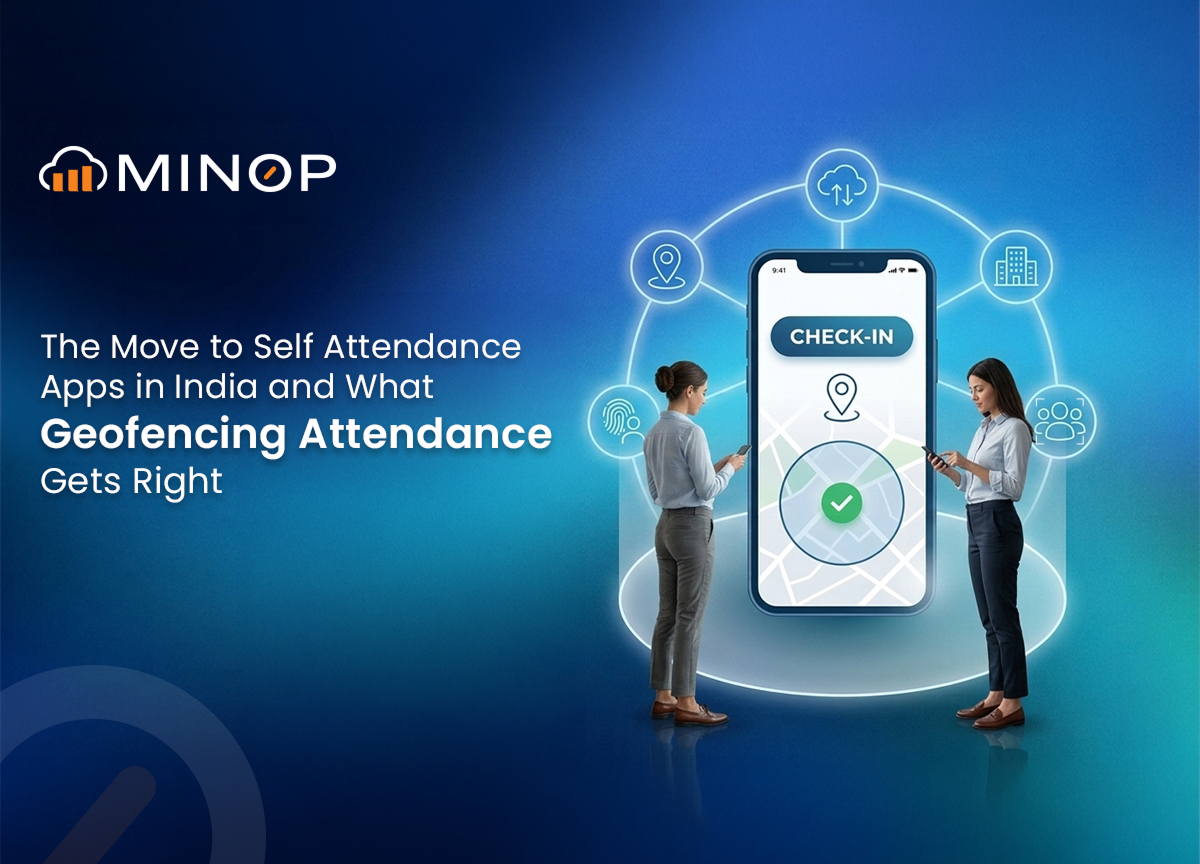
When an employee enters that boundary, the self attendance app detects their location and allows a clock-in. Similarly, when they leave, it records the clock-out. For employees, the experience is simple. They open the app, tap to clock in, and if they are within the geofence, it works. If they are not, it does not. There is no ambiguity.
The system works with GPS, Wi-Fi triangulation, or a combination of both. In India, GPS signal can be inconsistent inside buildings and in areas with high-rise density. Wi-Fi-assisted location fills in those gaps.
Pro Tip
A geofencing attendance app is not watching your workers all day. It is confirming they were where they were supposed to be when they said they were. That is a much easier conversation to have with employees than telling them their location is being monitored continuously.
Moreover, GPS tracking monitors where an employee is throughout the day. This distinction matters a great deal for employee trust.
For managers, the real-time dashboard shows who has checked in, where, and when. Likewise, for HR teams, the payroll integration is the biggest time-saver. Because attendance data is location-verified and automatically logged, payroll runs on cleaner data. There are fewer disputes about overtime, fewer corrections, and less time spent reconciling timesheets.
Where Geofencing Attendance Works Best in India
Since not every workplace is the same, geofencing attendance systems are particularly well-suited to several scenarios common across Indian industries.
Field and Contract Staff
Construction companies, infrastructure firms, and logistics operators manage workers across multiple sites. A geofencing attendance app lets HR set different geofences for each site. For instance, workers at a highway project in Pune and a building site in Hyderabad use the same app with location-specific boundaries.
Gig and Platform Workers
India's gig economy is formalising rapidly under the new labour codes, which extend social security obligations to platform workers. Attendance data is increasingly required for ESIC and PF compliance. A geofencing attendance system creates the verifiable, time-stamped presence records that statutory compliance now demands for this segment of the workforce.
Manufacturing and Industrial Sites
Large factories and industrial zones have defined physical perimeters. Setting a geofence around an existing site boundary is straightforward. For shift workers, the system can automatically flag clock-in attempts well before a shift starts from a location outside the factory gate.
Retail Chains and Distributed Outlets
A retail brand with 200 stores across India faces a real challenge in managing attendance data consistently from every location. A self attendance app with geofencing handles this from a single dashboard. Store managers do not need to chase timesheets, and the HR team sees attendance data for every outlet in real time.
Remote and Hybrid Teams
As IT and services companies move toward hybrid arrangements, some geofencing attendance apps support multiple approved locations per employee such as the Bengaluru office, a Mumbai client site, or a designated home work zone.
Self Attendance App vs. Traditional Biometric Attendance
| Factor | Traditional Biometric | Self Attendance App |
|---|---|---|
| Hardware required | Yes | No |
| Setup time | Days to weeks | Hours to days |
| Cost per location | High | Low |
| Works for field staff | Difficult | Yes |
| Buddy punching prevention | Yes (biometric ID) | Yes (geofence + liveness detection) |
| Payroll integration | Varies | Usually built-in |
| Offline support | Limited | Yes (many apps) |
| Data accessibility | On-premise (usually) | Cloud-based, real-time |
| Maintenance | Hardware servicing needed | App updates only |
Final Thought
The move toward self attendance apps in India is happening regardless of whether individual HR teams are ready for it. The cost of hardware, the problems with biometric maintenance, and the growing need to manage distributed and gig workforces are all pushing companies in this direction.
The question for HR leaders is not really whether to adopt a geofencing attendance system. It is which one fits your workforce, your sites, and your payroll process, and how quickly you can get it running.
FAQs
Most geofencing attendance systems require GPS to be active for clock-ins to go through. If location services are disabled, the app prompts the employee to turn them on. Some systems use Wi-Fi location as a fallback, which is particularly useful in dense urban areas or inside buildings where GPS signal weakens.
Some apps include checks for mock location tools, which are the most common way employees try to fake GPS. Better systems flag or block clock-ins from devices running known spoofing apps. If this is a priority, ask the vendor specifically how they handle newer Android builds, and consider requiring face liveness detection as a secondary check.
A well-designed geofencing attendance system captures location only at the moment of clock-in and clock-out. It does not continuously track employee location throughout the day. HR teams should communicate clearly with employees about exactly what is and is not recorded since resistance to these systems typically comes from confusion about surveillance, not from the actual data being captured.
Yes, and this is one of the strongest use cases in India right now. As the new labour codes extend ESIC and PF obligations to platform and gig workers, attendance records are increasingly required for statutory compliance. A geofencing attendance system provides the time-stamped, location-verified records that satisfy these requirements without adding hardware or administrative overhead.
Comments