TL;DR
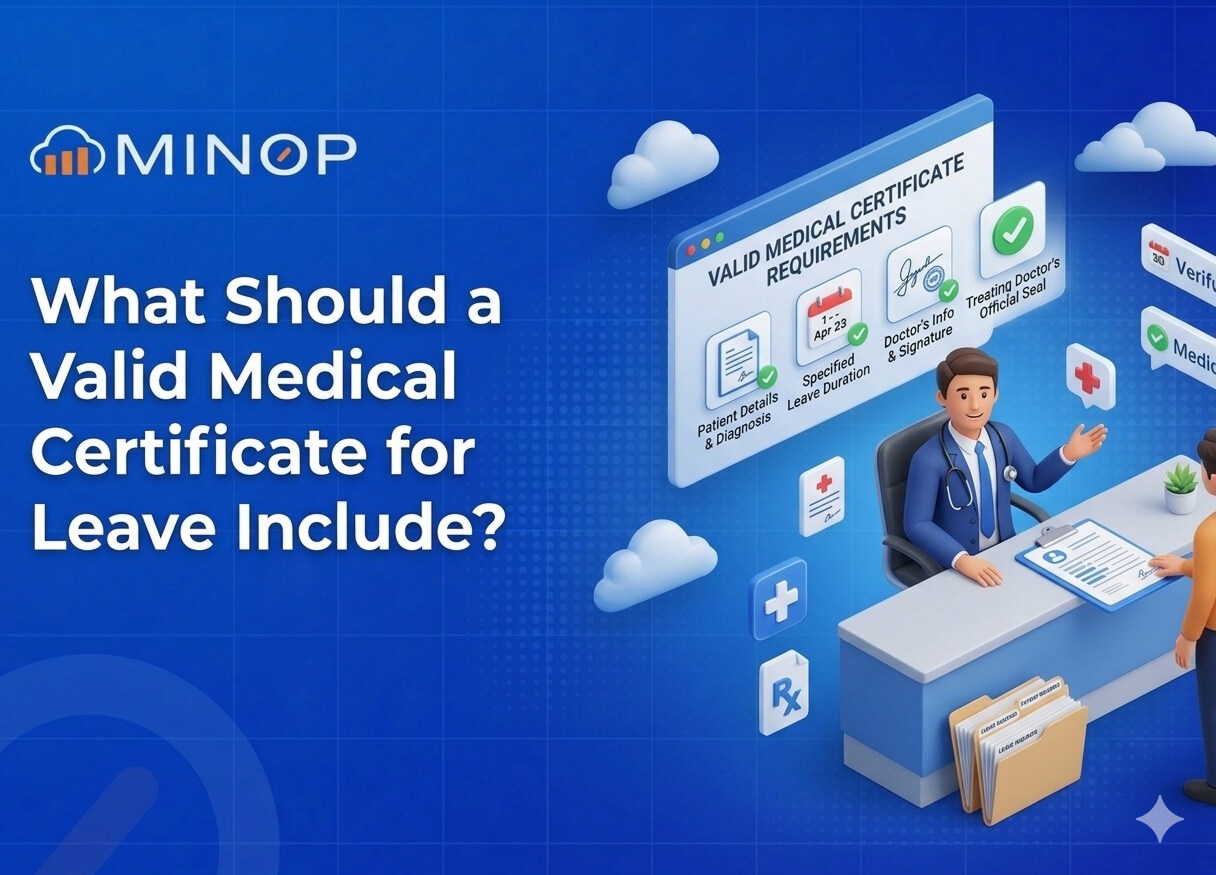
A valid medical certificate for leave needs the doctor's full name and NMC/State Medical Council registration number, official letterhead or stamp, the patient's details, a clear diagnosis or symptom description, specific dates of recommended rest, and a fitness-to-return note. Certificates missing any one of these - especially the registration number - are routinely rejected by HR. Telemedicine-issued certificates are now fully legal in India under the 2020 NMC Telemedicine Practice Guidelines, provided the same criteria are met. Everything else in this piece is about why each element matters, what HR should do when something looks off, and what employees should know before they walk into a clinic or open a teleconsultation app.
Introduction
There is a category of HR problem that is almost embarrassing in its mundaneness - not a restructuring, not a performance improvement plan, not a harassment inquiry - just a sick note from a doctor. And yet, year after year, the medical certificate for leave generates more disputes, more confusion, and more quiet resentment between employees and HR teams than almost any other compliance document in the Indian workplace.
Part of the reason is that no single central law in India prescribes an exact, universal format for a private-sector medical certificate. The Central Civil Services (Leave) Rules, 1972 specify Forms 3, 4, and 5 for government employees. The Factories Act, the Shops and Establishments Act (which varies by state), and the ESI Act each carve out different entitlements. Private companies fill the gap with their own leave policies - and those policies are often written in the fine print of an offer letter that nobody has opened since their joining date.
Each of these is a fixable, almost trivial issue - but it becomes a problem because nobody explained the rules clearly to begin with.
This post is an attempt to fix that. Think of it as a systems-level look at a document that the HR world treats as an afterthought - a document that, like a lot of things in workplace operations, turns out to have surprising depth once you start pulling on the thread.
6-12
Paid sick days/year
Under most Indian state S&E Acts3+
Consecutive absence days
That trigger certificate requirement2020
Year NMC Guidelines
Made online certs legally valid#1
Most common rejection
Missing doctor registration numberWho is Legally Authorised to Issue a Medical Certificate in India?
Under the National Medical Commission Act, 2019, only a Registered Medical Practitioner (RMP) - a doctor holding valid, current registration with the NMC or a recognised State Medical Council - is legally authorised to issue a medical certificate for leave. This sounds obvious, but it has real practical consequences. A certificate from a BAMS (Ayurveda) or BHMS (Homeopathy) doctor, for instance, is rejected by most private companies and many state-level rules that specify 'registered medical practitioner' to mean an MBBS or MD-qualified doctor.
The Central Civil Services Rules go further: for Gazetted Government employees, the certificate must come from a CGHS doctor, a government hospital, or an Authorised Medical Attendant. For Non-Gazetted employees, certificates from Registered Medical Practitioners are accepted, with some latitude for registered Ayurvedic, Unani, or Homoeopathic practitioners - but only if such certificates are accepted for the same purpose by the state government in whose jurisdiction the employee fell ill.
For the private sector, the operative test is simpler but equally clear: the doctor must be registered, the certificate must carry their registration number, and HR must be able to verify that registration against the National Medical Registry or the relevant State Medical Council database.
Also Read: Is Leave Encashment Taxable?
Does a Telemedicine Certificate Hold Up?
Yes, provided it meets the same criteria as any other certificate.
The NMC Telemedicine Practice Guidelines (March 2020) - issued as an appendix to the Indian Medical Council (Professional Conduct, Etiquette and Ethics) Regulations, 2002 - formally recognised teleconsultation as a valid mode of medical care. A certificate issued after a structured teleconsultation by an NMC-registered MBBS, MD, or MS doctor carries the same legal weight as one issued after a physical examination, provided it includes the doctor's NMC registration number, official stamp, and signature.
One other thing worth knowing: a doctor registered with any State Medical Council in India can issue a certificate to a patient anywhere in the country. There is no geographic restriction under the NMC Act. So an employee in Bengaluru who consults a Delhi-registered doctor via a telemedicine platform is receiving a perfectly valid, legally recognisable medical certificate for leave.
What Must Be on Every Certificate
There is no single prescribed format mandated by central Indian law for private-sector medical certificates - but both legal precedent and HR practice have converged on a set of non-negotiable elements. Think of these as the structural load-bearing components of the document. Any one missing element can cause the whole thing to collapse at the HR desk.
Doctor credentials and registration number
DOCTOR INFORMATION - REQUIRED FIELDS
Full name of the issuing doctor
Typed or printed, not just a signature. Handwritten-only names are a common rejection reason.
NMC or State Medical Council registration number
This is the single most important field. HR teams cross-reference this against the National Medical Registry. No registration number = immediate rejection.
Qualification (e.g., MBBS, MD General Medicine)
Relevant when the company policy specifies a minimum qualification threshold.
Official clinic letterhead or stamp with address and contact details
Handwritten certificates on plain paper are treated with suspicion and frequently rejected.
Doctor's signature (handwritten is fine; printed name must accompany it)
Patient and organisational details
PATIENT AND ADDRESSEE INFORMATION - REQUIRED FIELDS
Full name of the patient - exactly as it appears in the company's HR database
A name mismatch between the certificate and payroll records is a surprisingly common rejection trigger.
Age and gender of the patient
Address of the patient (at least city and state)
Certificate addressed to the specific employer or institution
Not 'To Whomsoever It May Concern'. This is a hard requirement on most telemedicine platforms and equally important on physical certificates.
Diagnosis, duration, and dates
CLINICAL AND TEMPORAL INFORMATION - REQUIRED FIELDS
Diagnosis or symptom description
Need not be exhaustive - 'Acute viral fever with body ache' is sufficient. 'Patient was unwell' is not. The certificate must establish a medical reason, not just an assertion.
Specific dates of recommended rest - not a vague 'a few days'
Format: '15-Apr-2026 to 19-Apr-2026' is unambiguous. '15/4/26' is not. HR systems require precision for leave accounting.
Date of examination / certificate issuance
The certificate date must align with or precede the leave period. A certificate dated after the leave has ended raises legitimacy questions.
Fitness-to-return note or return-to-work date (recommended for leaves exceeding 3 days)
Under CCS Rules, a government servant returning from medical leave must produce a Fitness Certificate (Form 5). Many private companies now include a similar requirement.
"The registration number is the single field that turns a document into a verifiable one. Without it, a certificate is just a piece of paper on a letterhead - and HR should treat it accordingly."
Seven Most Common Failure Points Found on a Medical Certificate
Here is where the operational reality diverges sharply from what most employees expect. Rejection is rarely about doubting the employee's illness. It is almost always about a document that cannot be verified, a field that is missing, or a certificate that creates more administrative problems than it solves. Understanding this - and communicating it clearly to employees before they submit - is one of the lowest-effort, highest-impact things an HR team can do.
| Failure Point | Why It Causes Rejection | Frequency |
|---|---|---|
| Missing doctor registration number | Cannot verify against NMC or State Medical Council database | Very common |
| 'To Whomsoever It May Concern' | Not employer-specific; raises authenticity questions | Very common |
| Certificate date after leave start | Implies certificate was obtained retrospectively | Common |
| Vague diagnosis ('patient was sick') | Does not establish a medical reason or justify leave duration | Common |
| No clinic letterhead or stamp | Handwritten plain paper; authenticity cannot be assessed | Common |
| Name mismatch with HR records | Cannot be matched to employee database entry | Common |
| Non-MBBS/MD issuing doctor | Company policy specifies Registered Medical Practitioner = MBBS/MD | Common |
One pattern worth flagging: HR teams in banking, aviation, and regulated industries tend to apply stricter scrutiny than their counterparts in IT services or consulting. The same certificate that sails through at a mid-sized tech company may be returned at an NBFC or a manufacturing firm with a formal compliance function. This is not inconsistency for its own sake - it often reflects audit obligations or sector-specific requirements that HR teams are not always good at communicating to employees.
Also Read: The Only Sick Leave Application Guide You'll Ever Need (With AI Prompts)
Fake Certificates and How Companies Detect Them
Let's talk about the thing that the polite version of this topic always skips over.
Fake medical certificates are not rare. They are not limited to a particular industry, salary band, or tenure level. They happen in organisations with strong cultural values and clear disciplinary policies, not just in workplaces where nobody is paying attention. The reason is almost never malice - it is almost always avoidance: of a difficult conversation with a manager, of a personal reason for absence that feels too private to share, of the administrative friction of getting a real certificate when you're genuinely unwell but just don't want to leave the house.
The detection methods that companies use have grown considerably more systematic. HR teams are now trained to cross-check doctor registration numbers against the National Medical Registry. Clinic contact details on the certificate are called directly. Digital certificates from telemedicine platforms often carry QR codes that allow real-time verification within 48 hours. Some organisations have begun using AI-powered document authentication tools that check metadata in scanned certificates, identify inconsistencies in fonts or formatting, and flag patterns - like a dozen employees using the same clinic for suspicious short-term leave around long weekends.
For employees:
Submitting a fake medical certificate is not a leave policy violation - it is fraud and forgery under Indian law. The consequences include immediate termination (with cause, affecting future employment), potential criminal prosecution, and a permanent mark on professional references. The risk calculus here is dramatically worse than people typically assume when they're just trying to extend a long weekend.
For HR teams, the more useful framing is cultural. Organisations where employees feel psychologically safe enough to say 'I need a personal day' or 'I'm dealing with a family situation' see dramatically lower rates of certificate fraud than those where sick leave is the only available escape valve. The document problem is often a symptom of a leave policy problem - one that can be addressed, carefully and without drama, through better policy design.
Building a Sensible Medical Leave Policy
The average leave policy in Indian private companies was written to prevent abuse, not to support wellbeing. This is visible in the language - 'medical certificate required for absences exceeding three days' - but also in the assumptions baked into how the policy is administered. The certificate is treated as proof that the employee was not lying, rather than as a standard piece of documentation that makes leave management cleaner for everyone involved.
A policy that works for both sides has a few characteristic features. It specifies clearly what a valid certificate must contain (the elements described above), so employees know what to ask for at the clinic. It distinguishes between short-term sick leave (1-3 days), extended sick leave requiring a doctor's certificate, and long-term medical leave requiring documentation from a specialist or hospital. It addresses the situation where an employee was genuinely too ill to obtain a certificate at the time - by allowing a certificate dated slightly later, accompanied by a note from the doctor confirming the earlier examination.
It also, importantly, addresses recertification. Under the FMLA framework in the US, employers cannot request recertification more frequently than every 30 days for an ongoing condition, and only in connection with an absence. Indian law does not prescribe this interval explicitly for private-sector employees - but the principle is sound. Asking an employee recovering from surgery to produce a new certificate every week is both administratively burdensome and medically questionable. A reasonable HR policy establishes a clear recertification cadence for extended leaves.
Also Read: What is Bereavement Leave?
Conclusion
A valid medical certificate for leave is, at its core, a simple document. It confirms that a qualified doctor examined a patient, established a medical reason for absence, and recommended a specific period of rest. The elements required - doctor credentials with registration number, patient details, employer addressee, diagnosis, dates, and signature - have remained consistent even as the format has evolved from a handwritten clinic note to a QR-verified telemedicine PDF.
What has changed is the operational context. HR teams now have the tools to verify certificates in minutes. Telemedicine has made genuine certificates more accessible than ever before. And the consequences of submitting a fraudulent one - for employees - are more severe, not less. The best thing an HR function can do is communicate the requirements clearly, before the moment of need, and build a leave culture where the medical certificate is an administrative formality rather than a trust test.
If one employee avoids a certificate rejection because they read this post, or if one HR policy gets a clearer checklist added to its employee communication pack, that's the kind of compounding return on writing time that makes this worth doing.
FAQs
Under the Central Civil Services (Leave) Rules, the authority competent to grant leave may secure a second medical opinion by requesting a Government Medical Officer not below the rank of Civil Surgeon. Private-sector companies have analogous provisions in their leave policies, though the right is less clearly codified. If an employer does request one, it must be done consistently - applying it selectively raises the risk of claims of unfair treatment or retaliation.
Many progressive HR teams already accept a certificate dated shortly after the leave period, provided the doctor notes when they originally examined or were consulted by the patient. Automatic rejection of backdated certificates, without any provision for genuine cases, creates unnecessary disputes and usually signals that the policy was written to catch abusers rather than support genuine illness.
In almost all Indian private companies, sick leave follows a 'use it or lose it' policy - it cannot be encashed and lapses at year-end. This is unlike earned or privilege leave. Leave encashment from privilege leave is taxable as salary income for private-sector employees, though specific government-sector retirement exemptions apply under Section 10(10AA) of the Income Tax Act.
Submitting a fake medical certificate constitutes fraud and forgery under Indian law - specifically attracting provisions of the Indian Penal Code related to document forgery and cheating. Employment consequences include immediate termination for cause, and legal consequences can include fines and imprisonment in severe cases. Most organisations maintain zero-tolerance policies for this type of misconduct.
Comments