TL;DR
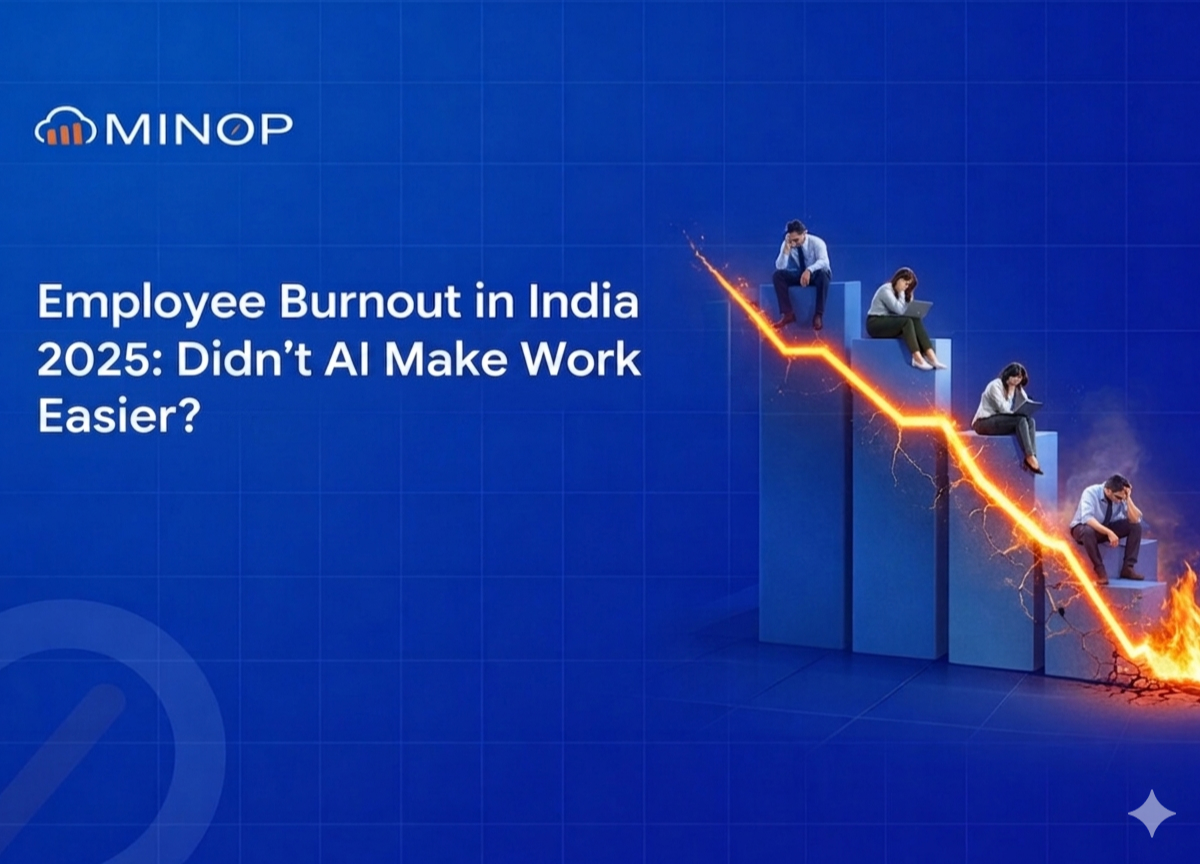
We were promised AI would take the work load off - fewer repetitive tasks, more breathing room. What actually happened? Management saw a faster tool and quietly raised expectations. Now workers are learning new platforms, sitting through reskilling sessions, worrying about job security, and still answering emails at midnight. Nothing really changed, except the exhaustion got deeper. India was already the burnout capital of the world at 62% - before AI entered the picture. And here's the painful irony: the most committed, hardworking employees are hit the hardest. AI didn't fix the broken system. It just accelerated it.
Didn't AI Make Work Easier?
It was supposed to. That was the whole pitch.
Generative AI would automate the boring tasks. Cut the grunt work. Give people back their time. Indian IT professionals - and workers across every sector - were told to adopt AI tools, learn new platforms, and watch their jobs get lighter.
Instead, something else happened.
According to a 2025 Harvard Business Review study, AI tools increased output expectations without reducing actual workload. Deloitte's 2025 Workforce Intelligence Report found that mental fatigue and cognitive strain have now surpassed workload volume as the leading predictors of burnout. Workers who use AI frequently experience up to 45% higher burnout rates than those who rarely use it, according to survey data cited by Forbes and the Workplace Mental Health Method.
India, already the world's burnout capital before AI entered the picture, now faces a compounded crisis. The pressure didn't go away. It changed shape.
62%
India's Burnout Rate
World's highest - before AI42%
Japan's Rate
Country that coined 'karoshi'28%
US Burnout Rate
Less than half of India'sThe National Sample Survey Organisation (NSSO) reports that 60% of employees suffer from workplace stress driven by long hours and high-pressure conditions. A 2024 CII-MediBuddy study found that 86% of a workforce of 50 million people - approximately 4.3 crore Indians - are mentally unwell at work.
This is the baseline. Before AI. Before the layoffs. Before the fear of automation settled into the daily routine of every IT professional in Bengaluru, Hyderabad, and Pune.
Has the Meaning of "Burnout from Work" Changed?
The World Health Organization classified burnout in ICD-11 as an occupational phenomenon caused by chronic workplace stress that has not been managed. It presents in three distinct ways:
Exhaustion
A deep depletion of physical and emotional energy that sleep alone does not fix.
Cynicism and Depersonalisation
A withdrawal from work, colleagues, and any sense of purpose.
Reduced Professional Ability
A measurable decline in the capacity to perform, not from lack of effort, but from a collapsed cognitive reserve.
This is not stress. Stress is short-term and resolves with rest. Burnout is what happens when stress continues past the point of biological recovery. A stressed employee can meet a deadline and feel relief. A burned-out employee meets the deadline and feels nothing.
"Over 90% of mental health concerns in Indian corporate settings are linked directly to workplace stressors - not to individual coping deficits. The problem is structural. The response has been personal."
- Mpower Foundation 2024
A 2024 Mpower Foundation study found that the overwhelming driver of mental health issues in Indian workplaces is the work itself - not personal weakness or poor resilience. Burnout disproportionately hits the most conscientious, most committed employees - the ones who say yes when they should say no, who stay late because they care. These are the people India's corporate sector depends on most.
How AI Made Burnout Worse
This is the part that surprises most people. AI was supposed to reduce cognitive load. The research says it often does the opposite.
The Cognitive Overload Problem
Deloitte's 2025 Workforce Intelligence Report found that mental fatigue and cognitive strain have overtaken raw workload volume as the biggest predictors of burnout. AI is a central driver of this shift.
When organisations adopt AI tools without changing how work is designed, the result is not less work - it's faster work, with higher expectations, and new skills required on top of existing responsibilities. Workers are expected to learn new platforms, attend reskilling sessions, maintain current output, and all of this happens on top of workloads that were already clinically unsustainable.
among frequent AI users vs. those who rarely use AI tools. Driven by cognitive overload and loss of task autonomy.
Survey data reported by Forbes, 2025
The Job Insecurity Spiral
A peer-reviewed study published in PMC (2025) found a direct link between AI awareness - defined as the extent to which employees perceive their job could be replaced by AI - and emotional exhaustion. The mechanism works in two steps: AI awareness increases job insecurity, and job insecurity increases emotional exhaustion.
A separate study published in Nature's Humanities and Social Sciences Communications (2024), using a three-wave research design across 416 professionals, found that AI adoption does not directly cause burnout - but it significantly increases job stress, which then drives burnout.
74%
of Indian workers fear
that AI will replace
their jobs
India-specific data
68%
of Indian white-collar
workers fear their role could be
automated within 5 years
of white-collar Indian workers
96%
of Indian professionals use AI tools
at work - yet 94% say mastering AI
is essential for career survival
Report 2025
The 'Second Job' Effect
Research cited by Built In (October 2025) describes the phenomenon where learning AI tools feels like a second job. Employees in India are expected to become proficient in generative AI platforms while simultaneously maintaining existing output levels - without meaningful extra time, support, or compensation.
The World Economic Forum projects that 44% of workers' core skills will change within five years. India's Skill India Mission was not built for this rate of change. Neither were the humans being asked to keep up with it.
"Instead of reducing workload, AI is reshaping it into something more cognitive, more constant, and harder to see."
- Brad Hook, Workplace Wellbeing Research, 2025
A New Clinical Category: AI-Induced Distress
Researchers at the University of Florida have proposed a new clinical classification - AI-Related Displacement Disorder (AIRD) - to describe the cluster of symptoms including professional identity loss, anxiety, insomnia, paranoia, and loss of purpose that arise specifically from AI-related job threats. Though not yet formally recognised in clinical manuals, it reflects a growing body of evidence that the psychological cost of AI displacement is real, measurable, and currently undertreated.
Why Overwork Produces Less Output
The logic driving Indian work culture is straightforward: more hours means more output. Decades of research disagree.
35%
drop in productivity
from chronic workplace stress
?51,000 Cr
annual cost of presenteeism
to Indian employers
2.6x
more likely to seek a new job
when burned out
Presenteeism means the employee is physically at their desk, producing a fraction of their actual capacity. Managers see full attendance. The productivity data tells a different story.
The neurological case is equally clear. Continuous overwork disrupts the brain's ability to regulate cortisol. Chronic cortisol elevation damages prefrontal cortex function - the part of the brain responsible for decision-making, problem-solving, and complex thinking. An employee working 14-hour days is not producing 140% output. Research suggests they are operating at closer to 60%, with a brain biochemically affected by the conditions their organisation created.
High job strain increases stroke risk by approximately 33%, per clinical studies. In Karnataka state alone, tech workers account for 20% of organ transplant patients - in a state where they represent a small fraction of the overall population. A study of IT employees in Hyderabad found that 84% had liver disease linked directly to sedentary, high-stress work conditions.
Read More: Lateral Hiring Meaning & Why It Matters
Are Indian Employees Structurally Trapped?
This is not about weak individuals. It's about a system designed in a way that leaves people with very few good options.
The Job Scarcity Trap
India graduates approximately 1.5 million engineering students per year. According to 2024 reports, roughly 10% of that cohort is likely to secure a formal job in their field. At the same time, TCS, Infosys, and Wipro collectively reduced their workforce by over 60,000 employees as part of AI-driven restructuring in 2024.
When an employee knows that 200 qualified candidates exist for every role they hold, they do not negotiate working hours. They accept the 11 PM meeting invite. They are grateful the salary arrives on the 1st.
The Cultural Normalisation of Overwork
India's most prominent business leaders have not been quietly promoting sustainable work. Narayana Murthy of Infosys called publicly for 70-hour workweeks. Bombay Shaving Company CEO Shantanu Deshpande told young professionals to 'grind' 18 hours a day. These are not fringe opinions. They are aspirational voices shaping how ambition is defined - and they normalise conditions that research classifies as harmful.
When the most successful people in a culture tell employees that suffering is the price of success, the culture internalises it. The person who leaves at 6 PM becomes a liability. The one who stays until midnight becomes a 'culture fit.'
The Monitoring Culture
Indian corporate employees consistently report feeling constantly watched as a major stressor. Managers set excessive demands without adequate support. Communication is frequently used to maintain uncertainty about job security - a tactic that research shows is neurologically indistinguishable from sustained threat exposure. The brain under persistent threat cannot perform complex work well. This is not an opinion. It is neuroscience.
What Requires Leadership Authority - And Where HR Must Be Direct
Name What Is Happening
Burnout is an occupational syndrome produced by chronic workplace stress - not a personal failure. Naming it accurately changes the internal story from 'I am failing' to 'the conditions I am working in are producing a predictable physiological outcome.' This is not comfort. It is the starting point for making rational decisions about your situation.
Identify What AI Cannot Replace
The professionals least at risk from AI displacement are those who have deliberately developed judgment under ambiguity, relational intelligence, ethical reasoning, and the ability to manage other humans well. Reskilling into AI-adjacent roles has value. The deeper protection is in building what AI is structurally incapable of doing.
Treat Boundaries as Performance Management
The employee who leaves at 6 PM, uses their annual leave, and declines the Sunday meeting is not underperforming. They are maintaining the cognitive and physical reserves needed for sustained, quality work over a multi-year career. The employee working 70-hour weeks is not an asset. They are a depreciating one.
Build Financial Resilience
Financial vulnerability is one of the primary mechanisms through which organisations keep burned-out employees who know they should leave but feel they cannot afford to. Emergency savings and marketable skill diversification are career management - not separate from it.
Seek Real Support
84% of corporate employees in India report low mood or depressive symptoms (HCL Healthcare research). 59% show signs of moderate to severe anxiety. If you recognise yourself in any of the burnout phases described above, the right response is clinical support - not a longer to-do list.
Conclusion
The 4.3 crore Indian employees who are currently mentally unwell are not struggling because they lack resilience. AI has added a new layer. The same employees who were already burned out are now expected to learn new tools, perform at higher AI-benchmarked levels, and live with the daily uncertainty of not knowing whether their role will exist in five years - while their organisation has not changed the structural conditions that were already breaking them. The problem is that fixing burnout requires changing how work is structured - and that authority does not sit with HR.
Key Takeaway
Burnout is not a resilience deficit. It is a structural outcome. Until organisations redesign how work is distributed, monitored, and measured - rather than simply adding AI tools on top of already unsustainable workloads - the crisis will continue to deepen. Tools like Minop Cloud can help HR teams track attendance patterns, monitor leave utilisation, and identify early warning signs of employee disengagement before burnout becomes irreversible.
FAQs
AI replaced some repetitive tasks but simultaneously raised performance expectations. Employees are now expected to use AI tools, attend reskilling programs, and maintain existing output levels - often without additional time or support. Research published in 2025 shows that frequent AI users experience up to 45% higher burnout rates than those who rarely use AI, due to cognitive overload, loss of task autonomy, and the psychological stress of constant technology change. AI shifted the nature of work, it did not reduce the volume.
The evidence leans toward increase, under most current conditions of adoption. A peer-reviewed 2024 study in Nature's Humanities and Social Sciences Communications found that AI adoption significantly increases job stress, which drives burnout. This is mediated by self-efficacy - employees who receive proper AI training show less stress response than those dropped into AI use without support. A separate 2025 PMC study found that AI awareness - the fear of being replaced - directly raises emotional exhaustion through job insecurity.
Burnout is classified by the World Health Organization in ICD-11 as an occupational phenomenon - a product of chronic workplace stress that has not been managed. A 2024 Mpower Foundation study found that over 90% of mental health concerns in Indian corporate settings are linked to workplace stressors, not individual coping deficits. Research consistently shows burnout disproportionately affects the most committed, conscientious employees - not the least motivated ones.
Key observable signs include: working beyond 70 hours per week consistently, responding to work messages late at night or on weekends, Sunday evening anxiety about Monday, declining quality in work output despite maintained effort, social withdrawal from colleagues, increased sick leave especially around weekends, physical symptoms like headaches or chronic fatigue, and a visible sense of cynicism toward the organisation or role.